
Basement Waterproofing
in Philadelphia, PA
Basement waterproofing in Philadelphia is not the same job as basement waterproofing in a subdivision. Most of this city was built before anyone poured a continuous concrete foundation wall, and it was built shoulder to shoulder.
In Fishtown, Manayunk, Roxborough, Mayfair, and Somerton, your basement wall is often someone else's basement wall too, and the water table under the row doesn't know where your property line is. See our full waterproofing process for how we diagnose before we quote, but this page is about what makes a Philadelphia basement different.
Philadelphia rowhouse and twin construction means basement waterproofing Philadelphia contractors have to solve for shared walls, zero-lot-line properties, and foundations that predate modern building code by a century. A crew that shows up with a one-size system built for a suburban ranch will miss half the problem.
We find where the water is actually coming from before we talk about a fix, because in a rubble-stone foundation from 1905, "where it's coming from" is rarely obvious.
Why Philadelphia Basements Get Wet
Start with the foundations themselves. A huge share of Philadelphia's rowhouse stock, especially in neighborhoods like Fishtown, Kensington, and parts of Manayunk, was built between the 1890s and 1920s on rubble-stone or brick foundations, not poured concrete.
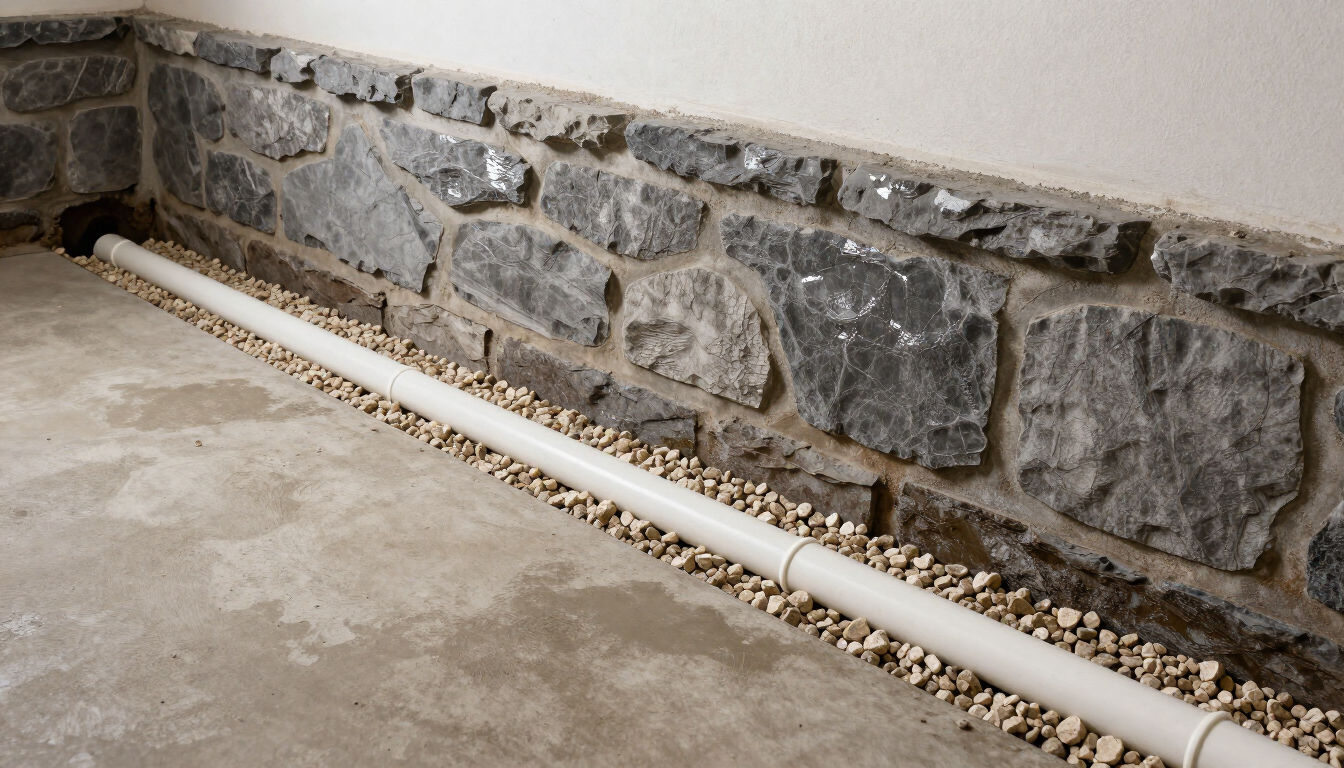
Rubble stone is exactly what it sounds like: irregular fieldstone and mortar stacked into a wall. It was never watertight to begin with. It was built to hold the house up, and the assumption at the time was that a coal-fired boiler kept the basement warm and dry enough by evaporation. Nobody today is running a coal boiler, and that assumption stopped holding decades ago.
Mortar joints in a rubble-stone wall degrade over a century of freeze-thaw cycles. Water moves through the wall by capillary action, wicking upward through the stone the way a paper towel pulls water from a puddle. That's different from a poured concrete foundation, where water usually enters through a specific crack or the cove joint where the wall meets the floor.
A brick foundation, common in Roxborough and parts of Mayfair, has the same vulnerability: brick and mortar are both porous, and a below-grade brick wall with no functioning exterior drainage absorbs groundwater until it pushes through to the interior face.
Then there's the row home itself. Philadelphia's rowhouses and trinity houses share party walls with the houses on either side.
That party wall usually extends below grade, which means your basement's water problem can originate from a neighbor's downspout, grading, or failed foundation coating, and there's very little you can do about their property to fix it. It also means the traditional fix for a leaking foundation wall, excavating the exterior and applying a new waterproof membrane, is often physically impossible.
There is no side yard. The house next to a Fishtown row home or a Manayunk twin is often literally attached, or set back a few feet with a shared fence and a sewer lateral running through the gap. You cannot dig a trench where there is no trench to dig.
Philadelphia also runs on a combined sewer system through much of the older city, meaning stormwater and sanitary sewage share the same pipe.
During heavy rain, that system backs up, and in a basement with a floor drain tied into it, backup pressure can push water up through the drain instead of down. That's a different mechanism than groundwater seepage through a foundation wall, and it needs a different fix, usually a backwater valve rather than exterior waterproofing.
Add the topography. Neighborhoods near Wissahickon Creek and the Schuylkill sit lower than the surrounding grade in places, and older stormwater infrastructure wasn't sized for today's storm intensity. A basement that stayed dry for forty years can start taking on water simply because a nearby lot was repaved with impervious surface and now sheds more water toward your foundation.
Common Problems in Philadelphia Basements
Rubble-stone and brick foundation seepage
Water wicking through porous stone or brick, worse along the party wall or the street-facing wall, showing up as damp patches, white chalky efflorescence, or a musty smell that gets stronger after rain.
Party-wall moisture with no exterior access
Water entering from a shared wall where excavation on one or both sides isn't possible, ruling out exterior membrane work and pointing toward an interior drainage approach instead.
Cove joint leaks in later additions
Many rowhouses had basements finished decades after the original build, and where a newer concrete floor meets the old stone or brick wall, that cove joint is a common entry point during heavy rain.
Sewer backup through floor drains
In combined-sewer areas of the city, heavy rain can push water back up through a floor drain rather than down, a problem that looks like a leak but isn't solved by waterproofing the walls.
Sump systems retrofitted into century-old basements
Many Philadelphia basements never had a sump because they weren't designed to need one. Adding one now means cutting carefully into old stone or brick footings, a different job than installing a sump in a basement built with one in mind.
How We Solve Them
Because so many Philadelphia basements can't be excavated from the outside, interior drainage is often the only realistic system. Our interior french drain system runs along the base of the foundation wall inside the basement, collecting water before it reaches the floor and routing it to a sump pump for discharge away from the house. It doesn't require touching the party wall or the neighbor's property, which makes it the practical answer for most Philadelphia rowhouses.
Where the foundation itself is compromised, whether that's a rubble-stone wall that's begun to bow, a stepped crack in a brick foundation, or settlement in an older structure, that's a foundation repair question, not just a moisture question. Our foundation repair page covers how we evaluate structural movement separately from water intrusion, because treating a structural problem like a cosmetic leak is how homeowners end up paying twice.
Sewer backup gets a different answer entirely: a backwater valve installed on the sanitary line, which physically blocks reverse flow during a surcharge event. That's a plumbing fix layered onto the waterproofing plan, not a substitute for it, and in a rowhouse basement with a floor drain, we check for it before we recommend anything else.
Cost depends heavily on what we find, which is exactly why we don't quote a system before we've seen the basement. General pricing ranges on our cost guide give you a starting point, but a rubble-stone party-wall basement and a 1960s block foundation are two different jobs even at the same square footage.
Thanks! We will be in touch shortly.
Why Elite Basement Solutions in Philadelphia
We're based in Feasterville-Trevose, not Philadelphia, and we're not going to pretend otherwise. We're a short drive from the Northeast, Bucks County, and the Route 1 corridor, and we've spent years working basements in exactly the housing stock described above, from rubble-stone rowhouses in the older city to block foundations further out. We're licensed and insured in Pennsylvania, PA HIC #PA209149, and we carry the same license into New Jersey.
We don't sell a single system and fit every basement to it. We diagnose first, because a Fishtown trinity house and a Somerton twin need different answers even though both are technically "in Philadelphia." Waterproofing systems we install carry a lifetime warranty on workmanship and materials, covering the waterproofing system itself, not foundation repair, finishing, or mold remediation, and it isn't transferable. We tell you that up front, not in fine print.
Trusted by homeowners across Bucks County and Philadelphia.
Every estimate starts with an on-site evaluation, not a phone quote. We walk the basement, identify where the water is entering, and explain the mechanism in plain language before we talk about a system. Financing options are available, and we accept Visa, Mastercard, Discover, check, Zelle, and Venmo.
(800) 902-5311 · info@elitebasementsolutions.com · Emergency service available 24/7 · view all service areas
Frequently Asked Questions
Why do so many Philadelphia row homes have wet basements?
Most Philadelphia row homes were built between the 1890s and 1920s on rubble-stone or brick foundations rather than poured concrete, and those materials were never designed to be watertight.
Rubble stone is fieldstone and mortar stacked into a wall, and over a century of freeze-thaw cycles, the mortar joints degrade and water begins moving through the wall by capillary action, essentially wicking upward the way a paper towel pulls water from a puddle.
That's a different failure mode than a modern poured-concrete foundation, where water usually enters through a specific crack or the cove joint at the base of the wall.
Row home construction adds a second factor: shared party walls. Your basement wall is often physically connected to your neighbor's, which means water can travel from their side of the property to yours, and there's no way to address their grading, downspouts, or foundation coating from your side.
Combined sewer systems in older parts of the city add a third mechanism, where heavy rain can push water back up through a basement floor drain rather than down.
Basement waterproofing Philadelphia contractors need to identify which of these three mechanisms, or which combination, is actually responsible before recommending a system, which is why we always start with an on-site evaluation rather than a phone estimate.
How much does basement waterproofing cost in Philadelphia?
Cost depends on the foundation type, the extent of water entry, and whether the fix is interior drainage, exterior work, or a combination, and we don't give a firm number until we've seen the basement in person.
A rubble-stone or brick foundation with capillary seepage across a full wall costs more to address than a single cracked poured-concrete wall, because the scope of work is larger and the materials behave differently.
Row homes with no side-yard access typically require interior drainage systems rather than exterior excavation, which changes the cost structure compared to a detached suburban home where excavation is an option.
Sewer backup issues add a backwater valve to the scope, which is a separate line item from wall waterproofing.
Our cost guide walks through the ranges and the variables that move the number up or down, but the only accurate quote comes from a free on-site evaluation where we've actually seen your foundation, your access, and where the water is entering.
Financing options are available if the recommended scope is larger than expected, and every waterproofing system we install carries a lifetime warranty on the workmanship and materials, though that warranty is not transferable and does not extend to foundation repair or finishing work.
Can you waterproof a row home basement with shared walls?
Yes, and it's the majority of what we do in Philadelphia.
When a basement wall is shared with a neighboring property, exterior excavation usually isn't possible, so the practical solution is an interior drainage system installed along the base of the foundation wall inside the basement.
That system intercepts water before it reaches the floor and routes it to a sump pump for discharge away from the house, and it doesn't require touching the party wall, digging on the neighbor's property, or coordinating access with anyone next door.
It works regardless of whether the water is originating from your side of the wall or theirs, because it's capturing water at the interior base of the wall rather than trying to block it from entering the wall in the first place.
If the party wall itself shows signs of structural movement, bowing, or a stepped crack, that's evaluated separately as a foundation repair issue, since a structural problem and a moisture problem need different fixes even when they're happening on the same wall.
We've installed these systems in trinity houses, standard rowhouses, and twins across the older parts of the city, and the approach adapts to whatever foundation material we find, whether that's rubble stone, brick, or block.
Do you serve all of Philadelphia or just certain areas?
We serve homeowners across Philadelphia, with a particular concentration in the neighborhoods closest to our Feasterville-
Trevose base: Fishtown, Manayunk, Roxborough, Mayfair, Somerton, Bustleton, and the rest of the Far Northeast, along with Port Richmond, Kensington, and Frankford.
Because we're based in Bucks County rather than within the city, we're not maintaining a Philadelphia office or storefront, and we're upfront about that rather than implying otherwise.
What that means for you is a company that's driven the Roosevelt Boulevard and Route 1 corridors for years and knows the difference between a Somerton twin's block foundation and a Fishtown trinity's rubble-stone wall before we ever walk into your basement.
Our Northeast Philadelphia page covers that sub-market specifically, since the Far Northeast's housing stock is genuinely different from the older river wards.
If you're outside the neighborhoods listed here, call (800) 902-5311 and ask, since service area decisions come down to drive time and scheduling, not a hard boundary on a map.
What is the best waterproofing method for an old Philadelphia basement?
For most older Philadelphia basements, an interior drainage system paired with a sump pump is the most reliable method, because exterior excavation is frequently impossible on a row home with no side yard.
The interior system runs along the base of the foundation wall, collects water at the source before it reaches the floor, and discharges it away through a sump pump, and it works on rubble-stone, brick, or block foundations alike.
It's not automatically the right method for every basement, though. If the foundation itself is bowing, cracked, or settling, that needs foundation repair addressed first, since waterproofing a structurally compromised wall treats the wrong problem.
If the issue is sewer backup rather than groundwater seepage, a backwater valve on the sanitary line solves it, and no amount of wall waterproofing will help.
That's why "best method" isn't a question we answer over the phone. We walk the basement, identify the specific mechanism bringing water in, and recommend the system built for what we actually find.
Philadelphia Neighborhoods We Serve
Fishtown · Manayunk · Roxborough · Port Richmond · Kensington · Frankford · Mayfair · Holmesburg · Torresdale · Somerton · Bustleton · Rhawnhurst · Fox Chase · Oxford Circle · Northeast Philadelphia · Wissahickon
Outside the city, see our full service area, including Bucks County, Montgomery County, and communities across the river in South Jersey.