Commercial Basement Waterproofing and Below-Grade Solutions
Commercial basement waterproofing is a different problem than residential waterproofing, and it requires a different scope of work: below-grade mechanical rooms, elevator pits, parking structures, and loading docks that cannot go offline for a homeowner's timeline. Elite Basement Solutions provides commercial waterproofing and below-grade water management for property managers, facilities managers, and building owners across Philadelphia, Bucks County, and Montgomery County who are responsible for an asset, a tenant roster, and a capital budget, not a single family's basement.
A water intrusion issue in a commercial building carries costs a residential leak does not: tenant complaints, liability exposure, damaged inventory or equipment in leased space, and a documentation trail an ownership group or lender will eventually ask to see. We scope, schedule, and document commercial waterproofing work with those realities built in from the first site visit.
Below-Grade Water Intrusion in Commercial and Multi-Tenant Buildings
Below-grade waterproofing failures in commercial buildings typically show up in mechanical rooms, storage areas, parking levels, and any space built into or below the surrounding grade. Hydrostatic pressure against a foundation wall does not distinguish between a single-family basement and a multi-tenant building envelope, the same principles of water movement apply, but the consequences of a failure scale with square footage, occupancy, and asset value.
Common failure points in commercial and multi-tenant properties include construction joints in poured foundation walls, penetrations for utility lines, aging or undersized sump and ejector pits, and negative-side hydrostatic pressure in structures where positive-side waterproofing was never installed or has degraded. We assess the building envelope as a system, not as isolated leak points, because a failure in one area often signals a condition affecting the broader foundation.
Elevator Pits, Loading Docks, Parking Structures, and Ejector Pits
These four areas account for a disproportionate share of commercial water intrusion calls, and they are areas most residential-focused waterproofing companies do not routinely service.
Elevator pits sit at the lowest point of the building envelope and are frequently subject to both groundwater infiltration and condensation. Standing water in an elevator pit is a code and safety issue as well as a maintenance one, and we address both the water source and the sump system serving the pit.
Loading docks combine below-grade or partially below-grade construction with heavy vehicle traffic and frequent door cycling, which stresses waterproofing membranes and seals differently than a static foundation wall. We evaluate dock seals, drainage, and wall waterproofing as a connected system.
Parking structures, whether below-grade or partially below-grade, deal with both hydrostatic pressure from surrounding soil and chloride exposure from vehicle traffic in winter, which accelerates concrete deterioration and membrane failure. We scope waterproofing repairs alongside an assessment of concrete condition where structural exposure is a factor.
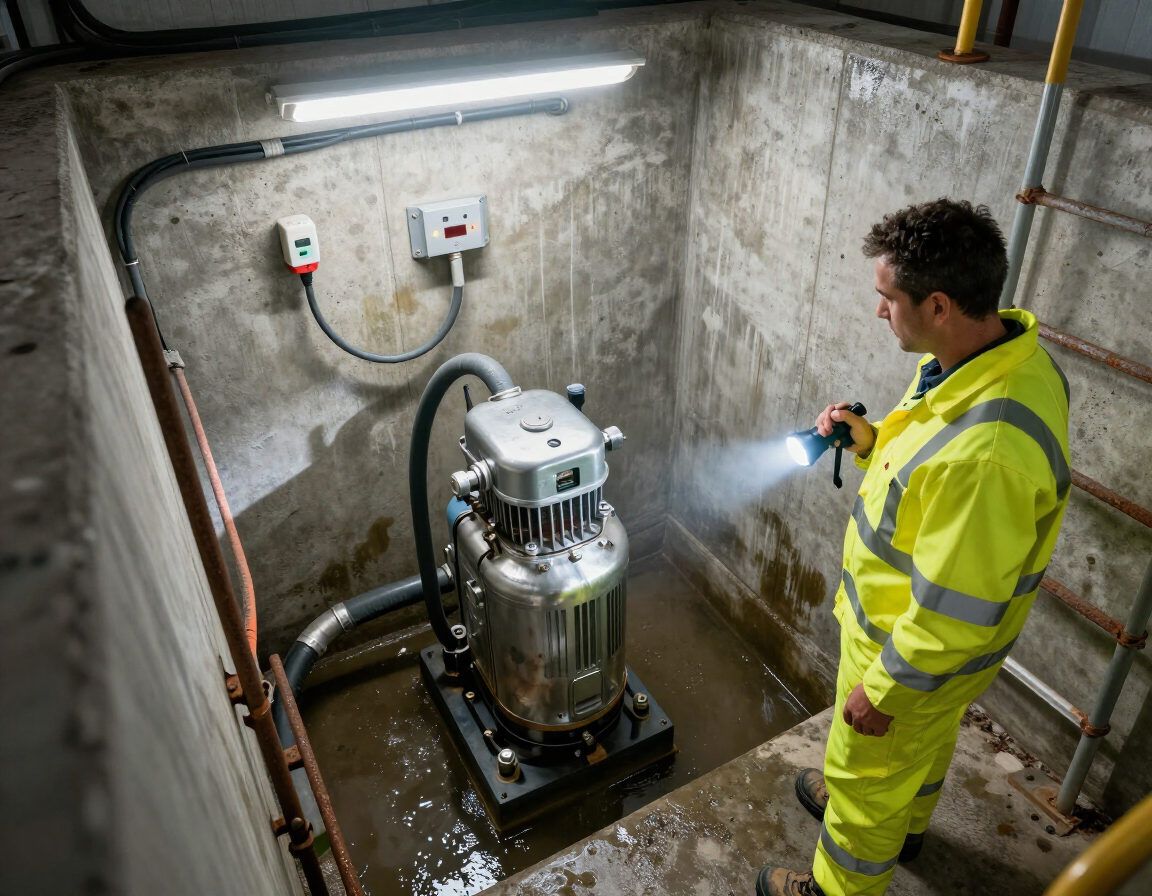
Sump and ejector pits serving commercial mechanical systems are often undersized for the building's actual water load, particularly in older properties where the mechanical infrastructure predates current occupancy or use. We evaluate pump capacity and redundancy as part of any commercial waterproofing scope, since a single point of pump failure in a commercial building has different consequences than in a house.
Scheduling Around Tenants — Occupied-Building and After-Hours Work
Tenant disruption is typically the primary constraint on a commercial waterproofing project, not the work itself. We schedule around building occupancy, coordinating after-hours work, weekend access, and phased scheduling for spaces that cannot be fully vacated during the project.
For interior work in occupied buildings, negative-side waterproofing in a leased basement level, injection work in an active parking structure, we plan access, containment, and noise-generating phases of the work around your building's occupied hours and tenant lease terms, not around our crew's convenience. Before work begins, we provide a schedule that identifies which phases require building access outside normal hours and which can proceed during standard operating hours with reasonable containment.
Negative-Side Waterproofing and Crystalline Systems
Most commercial waterproofing work is negative-side waterproofing, treatment applied from the interior face of the foundation wall, because the exterior of an occupied commercial building is rarely excavatable without significant cost and disruption. Negative-side systems have to manage water pressure pushing through the wall from the outside while being installed entirely from the inside, which is a different engineering problem than exterior positive-side waterproofing on new construction.
Crystalline waterproofing is one of the systems we use for negative-side applications on poured concrete walls. A crystalline coating reacts with moisture and unhydrated cement particles in the concrete to form crystals that fill capillary pores and hairline cracks, creating a barrier integral to the concrete itself rather than a surface coating that can delaminate. It performs well on structurally sound concrete with hairline cracking and consistent moisture exposure; it is not a substitute for foundation wall injection or structural repair where movement or larger cracks are present.
Foundation Wall Injection and Structural Repair
Where a commercial foundation wall has active cracking beyond hairline width, foundation wall injection, typically epoxy or polyurethane resin injected directly into the crack under pressure, seals the crack and, depending on the resin used, can restore some structural bond across it. We evaluate crack width, activity, and whether the crack indicates ongoing structural movement before recommending injection versus a broader structural assessment.
For buildings with larger structural concerns, bowing walls, settlement, or foundation issues beyond water intrusion, we coordinate with structural engineers as needed and provide documentation suitable for an ownership group's capital planning process, not just a repair invoice.
Documentation, Warranty Paperwork, and the Asset File
Property and facilities managers answer to an ownership group, and every commercial project we complete comes with documentation built for that reporting relationship: a written scope of work, before-and-after photo documentation, warranty paperwork specific to the systems installed, and an itemized invoice suitable for the building's asset file. Waterproofing systems installed carry Elite Basement Solutions' lifetime warranty on the waterproofing system itself, provided in writing at project completion for your records.
We provide this documentation as a standard part of project close-out, not as a special request, because we understand it is often required for insurance, lender, or ownership reporting purposes independent of whether a problem ever recurs.
Budgeting for Capital Expenditure Cycles
Commercial waterproofing frequently competes for capital budget against other building priorities, and we work with facilities and property managers on realistic timelines for that reality. A site assessment produces a scoped estimate you can bring into a capital planning cycle, including phasing options if a full project needs to be split across budget years.
For buildings managing ongoing risk, older construction, known problem areas, or properties in flood-prone parts of the Philadelphia and Bucks County service area, we also discuss scheduled maintenance options: periodic inspection of sump and ejector pit systems, pit pump testing, and monitoring of previously treated areas, so water issues surface as a line item on a maintenance schedule rather than an emergency call.
What to Expect From a Commercial Site Assessment
A commercial site assessment starts with a walkthrough of the affected areas, mechanical rooms, elevator pits, parking levels, loading docks, or wherever water intrusion has been reported, followed by an evaluation of the broader building envelope where relevant. We document existing conditions with photos, identify probable source points, and provide a written scope and estimate, along with a proposed schedule that accounts for occupancy and tenant considerations.
We also handle foundation repair and French drain installation for commercial and multi-tenant properties where exterior drainage is contributing to the water intrusion, and we scope residential-grade basement waterproofing for mixed-use buildings with residential units above commercial space. Property managers overseeing buildings in the city can review our work specific to that market on our Philadelphia waterproofing page.
Read feedback from past clients on our reviews page.
Elite Basement Solutions is licensed and insured, holding PA HIC #PA209149 and NJ HIC #13VH14034100, and serves commercial properties throughout Philadelphia, Bucks, Montgomery, Chester, and Delaware counties in Pennsylvania, and all of New Jersey (statewide).
Thanks! We will be in touch shortly to schedule your site assessment.
Commercial Site Assessment Request
Frequently Asked Questions
What is the difference between commercial and residential waterproofing?
Commercial waterproofing addresses larger, more complex building envelopes, different occupancy and access constraints, and a documentation standard that residential work does not require. A single-family basement is typically one contiguous space with straightforward access and no tenants to schedule around; a commercial or multi-tenant building involves elevator pits, parking structures, loading docks, and mechanical rooms, often with multiple tenants whose leases and operating hours constrain when and how work can be performed. Commercial projects also carry a higher standard of documentation, written scope of work, photo documentation, and warranty paperwork suitable for an asset file, because property and facilities managers answer to an ownership group or lender, not just themselves. The waterproofing methods overlap in principle: hydrostatic pressure against a foundation wall behaves the same physically whether the building is a house or an office. What changes is the scale of the systems involved, the coordination required to perform work in an occupied building without disrupting tenants, and the reporting expected once the project is complete. We treat commercial waterproofing as a distinct service line with its own process, not a residential job scaled up.
Can you waterproof a building while it is occupied?
Yes, most commercial waterproofing work we perform happens in occupied buildings, and we schedule and phase the project specifically to minimize tenant disruption. This typically means after-hours or weekend work for phases that generate significant noise, dust, or require extended access to leased or common areas, combined with containment measures for any work performed during standard building hours. Before a project begins, we provide a schedule that identifies exactly which phases require off-hours access and which can proceed during the day with reasonable containment in place, so building management can communicate specifics to affected tenants in advance. Negative-side waterproofing methods, the approach used for most interior commercial work, are specifically suited to occupied buildings because they do not require exterior excavation, which would be far more disruptive and often is not feasible on a commercial property with limited perimeter access. We coordinate directly with property or facilities management on access logistics, security requirements, and any building-specific protocols throughout the project, treating scheduling as a core part of the scope rather than an afterthought.
How much does commercial waterproofing cost?
Commercial waterproofing cost depends on the scope and scale of the areas affected, a single elevator pit repair is a very different project than waterproofing an entire below-grade parking structure or multiple mechanical rooms across a building. Access constraints also factor into cost: work that requires after-hours scheduling, coordination with multiple tenants, or extended containment measures takes longer and costs more than the same physical scope performed with unrestricted daytime access. The waterproofing method matters as well, negative-side crystalline coating for hairline cracking is a different cost profile than foundation wall injection for active structural cracks, or a full sump and ejector pit system replacement. We do not publish commercial pricing because the variables are too building-specific to make a general number useful for budgeting purposes. A site assessment produces a written, itemized estimate scoped to your specific building and constraints, structured so it can be used directly in a capital planning cycle, including phasing options if the project needs to be split across budget periods.
Do you work on elevator pits and loading docks?
Yes, elevator pits and loading docks are among the areas we most frequently service for commercial clients, along with parking structures and sump and ejector pit systems. Elevator pits sit at the lowest point of a building's envelope and are prone to both groundwater infiltration and condensation, which creates both a maintenance issue and a code and safety concern when standing water is present. We evaluate the water source affecting the pit as well as the adequacy of the sump system serving it, since an undersized or failing pump is frequently part of the problem even when the water source itself is addressed. Loading docks present a different challenge because they combine below-grade or partially below-grade construction with heavy vehicle traffic and constant door cycling, both of which stress waterproofing membranes and seals in ways a static foundation wall does not experience. We assess dock seals, drainage, and wall waterproofing together rather than treating them as separate problems, since a failure in one area typically compounds the others over time.
What documentation do you provide for property managers after a commercial waterproofing job?
Every commercial project closes out with a documentation package built for asset file and ownership reporting purposes, not just a paid invoice. That package includes a written scope of work describing exactly what was performed and where, before-and-after photo documentation of the affected areas, warranty paperwork specific to the waterproofing systems installed, and an itemized final invoice suitable for capital expenditure or maintenance records. Waterproofing systems we install carry Elite Basement Solutions' lifetime warranty on the waterproofing system itself, and that warranty is provided in writing as part of the close-out package, not verbally. We provide this documentation as standard practice on every commercial job because we understand property and facilities managers frequently need it for insurance purposes, lender reporting, or an ownership group's own records, independent of whether any issue ever recurs in the treated area. If a specific documentation format is required by your organization, a particular report structure or additional detail for an asset management system, we can typically accommodate that request; let us know before the project begins so it can be built into the close-out process.