
Sump Pump Installation, Replacement and Backup Systems
A sump pump only has to fail once. Sump pump installation in Philadelphia and the surrounding counties is not complicated work, but it is work that gets undersized, oversold, or installed without a backup plan more often than any other piece of a basement waterproofing system. The pump itself matters less than most homeowners think — sizing, the discharge line, and what happens when the power goes out are what actually determine whether a basement stays dry during the storm that counts.
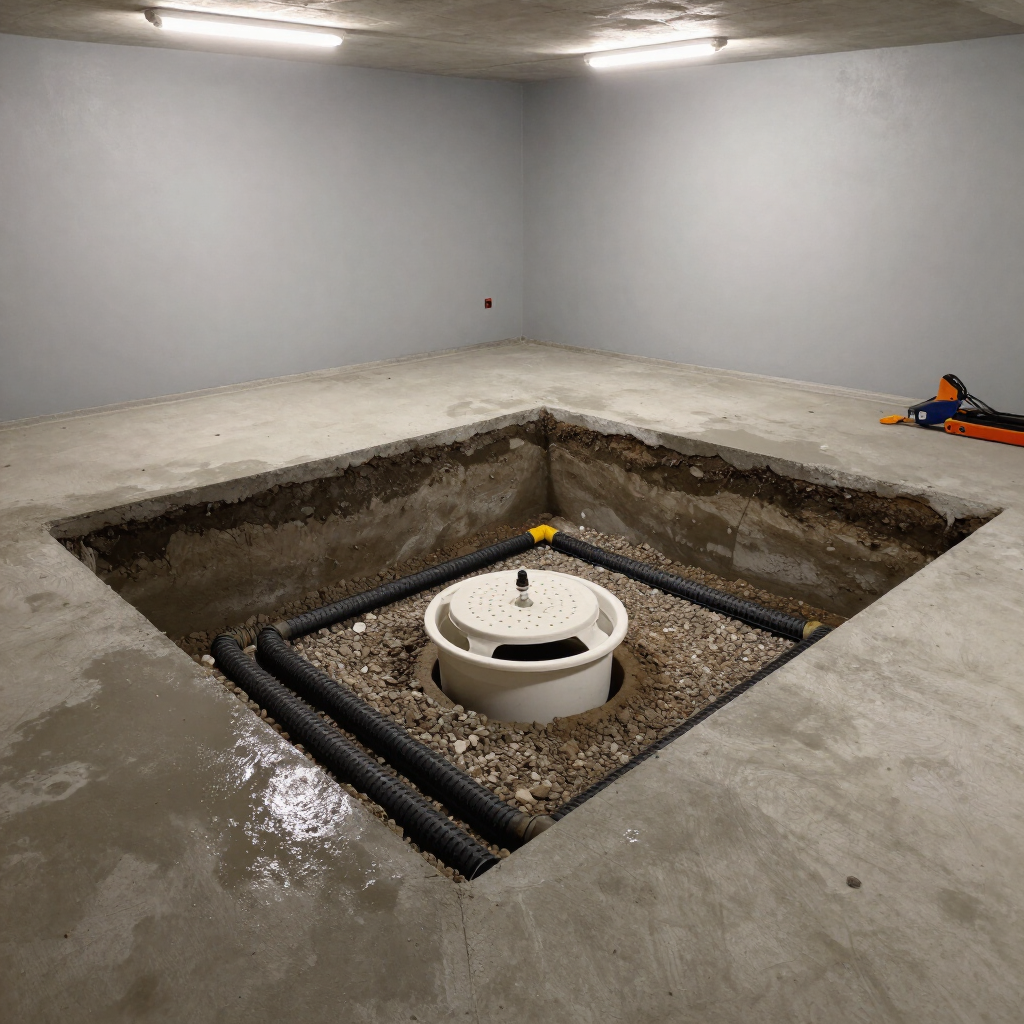
A sump pump is the last stage of any drainage system. Water collected by an
interior French drain or exterior footing drain flows into a sump basin set below the basement floor, and the pump's job is to move that water out and away from the foundation before it rises high enough to flood the floor. Every part of that chain has to work for the system to work.
Horsepower sizing is not a guess — it is a calculation based on how much water the drainage system can deliver during a heavy rain event, the vertical lift distance to the discharge point, and the discharge line's length and configuration.
A pump undersized for the basin's actual inflow will run constantly and burn out early. An oversized pump wastes money and causes excessive pump cycling — turning on and off in rapid succession, wearing out the motor and float switch faster than steady operation.
We size every sump pump to the specific basement, not to a shelf model. A submersible pump, sealed and mounted inside the basin itself, is the standard choice for most installations because it runs quieter and keeps the motor protected from debris.
A pedestal pump, with the motor mounted above the basin, is reserved for basins too shallow or narrow for a submersible unit — a compromise, not a standard recommendation.
The Real Failure Modes
Most sump pump failures in this region are not a burned-out motor. They are three specific, predictable things, and every one of them is preventable with the right installation and maintenance.
A Stuck Float
The float switch tells the pump to turn on when water rises and off when it drops. Debris, sediment, or a misaligned float can jam the switch off, the pump sits there doing nothing while the basin fills around it. A tethered float on too short a cord, or a vertical switch installed too close to the basin wall, is a common and avoidable cause.
A Frozen Discharge Line
Every January, we get calls from homeowners whose pump ran fine but the basement flooded anyway, because the discharge line froze solid where it exits above grade. The pump keeps pumping into a blocked pipe, pressure builds, and water backs up or the pump burns out working against the blockage. Correct pitch, insulation where exposed, and proper termination matter more to winter reliability than the pump itself.
Power Cut During the Storm That Needed It
The single most common reason a sump pump fails during a major storm is that the power goes out, often from the same storm driving the water. A primary pump with no backup power source is only as reliable as the grid during the worst weather of the year, exactly when it's least reliable.
A backup system exists specifically to cover the gap when the primary pump cannot run — power outage, primary pump failure, or a storm event that overwhelms a single pump's capacity. There are two real options, and each has an honest limitation worth knowing before you buy one.
Battery Backup vs. Water-Powered Backup
Battery Backup
Battery backup sump pump systems run a secondary pump off a deep-cycle marine or dedicated sump backup battery, kicking in automatically when the primary loses power or fails.
Runtime depends entirely on battery capacity and how hard the pump has to work — a typical system moving water at a moderate rate can run several hours to more than a day on a single charge, but heavy inflow during a major storm can draw that down to a few hours.
Batteries need periodic testing and replacement every few years; a backup with a dead battery is not a backup.
Water-Powered Backup
Water-powered backup pumps use municipal water pressure to create suction that moves water out of the basin, with no battery or electricity required.
They run for as long as the water supply stays pressurized, immune to the exact failure mode — power loss — that battery backups exist to cover.
The trade-off is water usage: several gallons consumed for every gallon of sump water removed, and it requires an available water line with adequate pressure, so it's not an option on a well.
Most homes benefit from a battery backup as the standard recommendation, with a water-powered backup considered for homes prone to extended outages. We walk through both options and their actual runtime numbers for your setup during a free on-site evaluation.
Discharge Line: The Part That Gets Skipped
The discharge line does more to determine whether a sump pump system holds up over years than the pump itself, and it's the part most often installed as an afterthought. A check valve close to the pump prevents water from flowing back into the basin between cycles, without one, the pump has to re-lift the same water repeatedly.
Freeze protection where the line exits the house, proper pitch, and a termination point that doesn't dump water back toward the foundation are all part of a correctly installed system, not optional upgrades.
An alarm system, a simple, low-cost sensor that sounds when water in the basin rises above the expected level, gives an early warning if the primary pump is struggling, before the basement floods rather than after. We include this as a standard recommendation on backup installations because it's the cheapest insurance in the entire system.


Sump pump work is rarely the whole story for a wet basement, see how it fits into a complete basement waterproofing system, and how it pairs with interior and exterior drainage (french drain install) to move water out once it is collected.
Elite Basement Solutions serves Philadelphia, Bucks, Montgomery, Chester, and Delaware counties in Pennsylvania, and all of New Jersey (statewide). Licensed and insured, PA HIC #PA209149, NJ HIC #13VH14034100. Emergency service available 24/7. Financing options available.
Frequently Asked Questions
How much does sump pump installation cost?
Sump pump installation cost depends on whether you're installing a new system from scratch, including a new basin, or replacing an existing pump in an existing basin, and whether a battery or water-powered backup is included.
A straightforward replacement into an existing, properly sized basin costs less than a full new installation requiring excavation and electrical work.
Sizing is the real cost driver, not the pump brand. A pump sized correctly for your drainage inflow and lift distance costs more upfront than an undersized off-the-shelf unit but avoids the premature failures and repeat calls that come with sizing it wrong.
Adding a backup system increases installed cost, since it involves a second pump and, for battery systems, a dedicated battery.
We don't quote sump pump work over the phone, because basin condition and existing electrical access vary enough between homes that an accurate number requires seeing the site.
A free on-site evaluation gives you an exact quote. Financing options are available. Call (800) 902-5311.
Do I need a battery backup sump pump?
If your primary sump pump runs on standard household electricity with no secondary power source, you have no protection against the single most common reason sump pumps fail during major storms: the power going out.
A battery backup addresses exactly that gap, running a secondary pump automatically when the primary loses power.
Whether you need one depends on your situation. Homes prone to power outages during storms, homes where a flooded basement would cause serious damage, and homes relying on a single pump with no redundancy benefit most from adding a backup.
A battery backup runs for several hours up to more than a day depending on capacity and how much water it has to move, covering most typical outage durations.
For extended outages, or where a battery's runtime ceiling is a real concern, a water-powered backup is worth considering instead, since it runs on municipal water pressure with no battery to run down.
We walk through the actual trade-offs and realistic runtime numbers for your home during a free on-site evaluation.
How long do sump pumps last before they need replacement?
Most residential sump pumps last around seven to ten years under normal operating conditions, though a pump undersized for its basin's inflow, cycling excessively due to a missing check valve, or running in heavy sediment can fail considerably sooner.
A correctly sized pump with proper maintenance can run reliably at or beyond the higher end of that range.
Signs a pump is nearing the end of its life include louder or rougher operation, longer run times to clear the same water, visible rust or corrosion, and a float switch that sticks or responds inconsistently.
Any of these is worth a service call before the pump fails outright, particularly heading into a wet season.
We recommend testing a sump pump periodically by pouring water into the basin and confirming it activates and shuts off correctly, and checking that the discharge line outside is clear, especially before winter when a frozen line is the more common failure point than the pump itself.
If your pump is approaching typical service life, a free on-site evaluation can tell you whether replacement now avoids an emergency call during the next major storm.
Why does my sump pump run constantly?
A sump pump running constantly, rather than cycling on and off as water rises and clears, points to one of a few specific problems, and none of them is normal operation.
A stuck float switch, jammed by debris or sediment, can keep the pump running even after the water level has dropped, since the switch never signals it to stop.
A missing or failed check valve lets water flow back down into the basin between cycles, so the pump ends up re-lifting the same water repeatedly — this shows up as frequent short cycling but produces the same symptom of a pump that never rests. An undersized pump working against inflow it was never sized to handle will also run near-continuously during heavy rain, simply because it cannot keep pace.
Less commonly, a genuinely high water table or a drainage system delivering more water than expected — sometimes from a grading problem or a downspout discharging too close to the foundation — can push a properly sized pump into extended run times. A constantly running pump is burning out faster than it should regardless of cause, so it's worth a service call rather than waiting for it to fail. (800) 902-5311.
What happens if my sump pump fails during a storm?
If a sump pump fails during a storm with no backup in place, water collected by the drainage system has nowhere to go and rises in the basin until it overflows onto the basement floor.
This is the exact scenario a battery or water-powered backup exists to prevent, since backups activate automatically when the primary stops working, whether from power loss, a stuck float, or motor failure.
The most common cause of primary pump failure during a storm is a power outage from that same storm — exactly when the pump is needed most and least likely to have grid power.
A frozen or blocked discharge line can cause a similar outcome even with power intact, since the pump keeps running but the water has nowhere to exit.
Emergency service is available 24/7 for pump failures in progress, though we cannot promise a specific response time, since that depends on storm conditions and current call volume.
The more reliable protection is preventing the failure in the first place: a correctly sized pump, a properly installed discharge line with freeze protection, and a backup system sized to your basement's needs.
Call (800) 902-5311 to schedule a free on-site evaluation before the next storm, not during it.