Basement Mold Remediation
in Philadelphia and Bucks County
Mold in a basement is a symptom, not a standalone problem. It grows because moisture is present and sustained, and if that moisture condition isn't identified and corrected, the growth returns no matter how thoroughly the surface is cleaned. Elite Basement Solutions provides basement mold remediation across Philadelphia, Bucks County, and Montgomery County, and because we're also a waterproofing contractor, we treat the mold and the moisture source that fed it as one project instead of two separate service calls.
Why Basements Grow Mold
Mold needs three things to establish itself: a food source (which almost any organic building material provides — wood framing, drywall paper, cardboard, dust), a temperature range that covers most of the year in this region, and moisture. The moisture is the only variable a homeowner has any real control over, and in a basement, it shows up in two different ways that call for two different fixes.
The first is direct water intrusion — the same cove-joint seepage, wall cracks, and block-core leakage that shows up on our basement waterproofing page. Water enters during storms or snowmelt and keeps framing, drywall, and stored materials damp long enough for mold to take hold, even if no one ever sees standing water on the floor.
The second is condensation, and it doesn't require any water entering the basement at all. Basements sit below grade, which means the concrete walls and slab stay several degrees cooler than the air above ground for most of the year. Warm air holds more water vapor than cold air, and every volume of air has a dew point — the temperature at which it can no longer hold its moisture and that moisture condenses out as liquid water. When warm, humid air (from outside in summer, or from a dryer vent, bathroom exhaust, or just normal household activity) contacts a basement wall, ductwork, or water line that's colder than that air's dew point, the moisture condenses directly onto the surface.
Relative humidity — the percentage of moisture the air is holding compared to the maximum it could hold at that temperature — routinely runs above 70 percent in an unmanaged Philadelphia-area basement through the summer months, and mold growth accelerates once relative humidity near a surface stays above roughly 60 percent for an extended period.
Poor ventilation and exhaust vents that terminate inside the basement instead of outside the house make this worse, adding moisture to the air with no way for it to leave. In homes with a crawl space instead of a full basement, a related mechanism drives the same result — ground moisture wicking up through an unsealed dirt floor and humid outside air pulled in through foundation vents, which we address through
crawl space encapsulation.
Signs of Mold in Your Basement
Visible growth is the most obvious sign — dark or discolored spotting on drywall, framing, insulation, or stored boxes, often clustered along the foundation wall, around windows, or near plumbing lines. A musty or earthy odor, particularly one that's strongest right when you walk in and fades the longer you're down there, is frequently a sign of growth happening somewhere out of sight, such as behind drywall or under flooring.
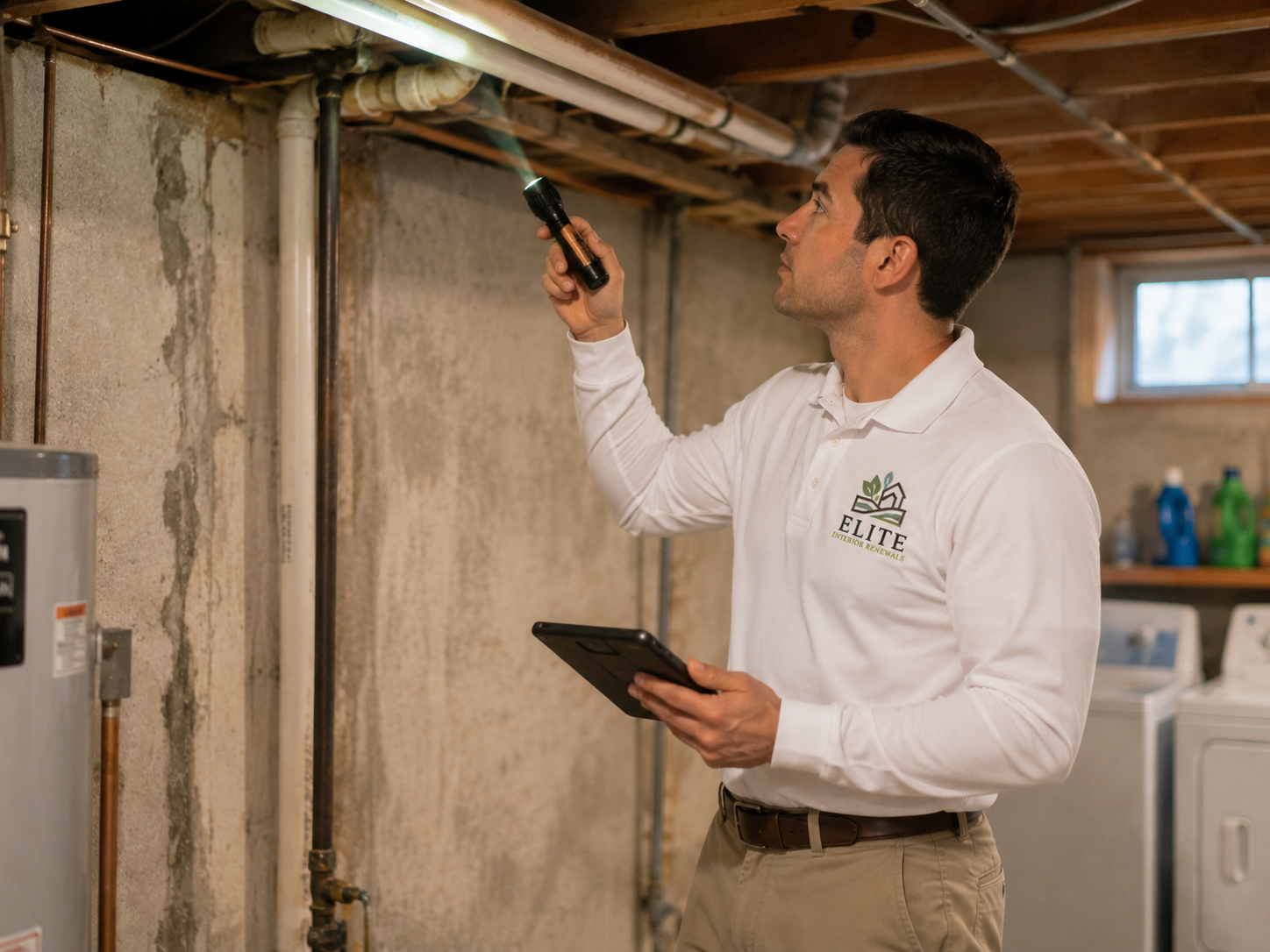
Beyond what's visible, we look for the physical conditions that support mold whether or not growth has appeared yet. That starts with a moisture meter, a handheld tool that measures moisture content inside wood framing, drywall, and other building materials without cutting into them — a reading well above normal for the material tells us the surface has been staying wet longer than it should.
We also check relative humidity in the space directly, look for condensation on ductwork and cold water lines, and look for efflorescence — the white, chalky mineral deposit left on concrete as water evaporates through the wall, a reliable sign that moisture has been moving through the concrete even if the wall looks dry on the day of the inspection. Peeling paint and warped baseboards round out the physical picture.
We describe what we find in these plain, physical terms — what's affected, what condition it's in, and what moisture source appears to be driving it.
How We Remediate Basement Mold
Containment First
Before materials are disturbed, we establish containment using physical barriers to isolate the affected area and prevent mold spores from spreading to clean areas of the basement or home.
For larger or heavily affected spaces, we add negative air containment, maintaining lower air pressure inside the work zone so air flows inward and exiting air is filtered before release.
HEPA Filteration
Air moving out of the containment area, and air used to clean the space during and after the work, passes through HEPA filtration — a filter standard capable of capturing the very small particles mold spores fall into, rather than a standard shop-vac filter that lets them pass straight through.
Removal Vs Treatment
This distinction drives most of the decision-making during remediation. Porous materials with significant growth — drywall, insulation, carpet, cardboard — generally can't be fully cleaned, because mold grows into the material itself and not just on its surface, so affected sections are removed and disposed of rather than treated in place.
Non-porous and semi-porous surfaces — framing lumber, concrete, most finished surfaces — are cleaned and then treated with an antimicrobial treatment, a product formulated to kill remaining mold and inhibit regrowth on the surface.
On some surfaces, we follow that treatment with an encapsulant, a sealant-like coating applied over treated wood or concrete that locks down any residual spores and provides a fresh, sealed surface going forward.
Source Removal
This is the step a surface-only cleaning skips, and it's the step that determines whether the fix holds.
If the source is active water intrusion, we install the correct waterproofing system as part of the same project — interior drainage, exterior excavation, or targeted crack repair, detailed on our basement waterproofing page.
If the source is condensation driven by relative humidity, we address ventilation and install a dehumidifier sized to the actual cubic footage and moisture load of the space — dehumidifier sizing matters here, because an undersized unit runs constantly without ever pulling relative humidity down to a level that stops condensation, and an oversized one is money spent on capacity the room doesn't need.
Post-Remediation Verification
Once removal, treatment, and source correction are complete, we walk the space again to confirm affected materials are gone or properly treated and that the moisture condition that caused the growth has actually been resolved, not just the visible symptom.
Why Remediation Without Waterproofing Fails
Most mold remediation companies do one thing: they remove and treat visible growth, then leave. If the moisture behind that growth was never identified or corrected, the fix is temporary by definition — the same conditions that grew the mold the first time are still in place, and mold returns, frequently in the same spot, sometimes within months. We see this pattern often: a homeowner calls us after already paying another company once for remediation that didn't hold.
We're built differently on this point because waterproofing is our primary trade, not a side offering attached to a cleaning service. A mold call from us starts with the same diagnostic process we use on a wet-basement call — find the actual water or humidity source before proposing a fix.
If that source is a cove-joint leak, a cracked wall, or a humidity problem with no active leak at all, we say so and price the source correction separately from the remediation itself, so a homeowner can see exactly what they're paying for and why. Remediation without that step isn't a complete fix — it's a repeat purchase waiting to happen.
Why Remediation Without Waterproofing Fails
Air sampling and surface sampling are diagnostic tools, not remediation steps. Air sampling measures mold spore levels in the air, while surface sampling identifies the type of mold growing on a specific material.
Testing can be useful when there is no visible growth but a persistent odor or health concern, before and after major mold remediation, or during real estate transactions when documented, third-party data is needed.
Testing is usually not worth the added cost when mold is already visible and the moisture source is identifiable.
If we can see the growth, identify affected materials, and trace the moisture to water intrusion or a humidity problem, lab testing typically won't change the remediation plan. We'll tell you directly whether testing makes sense during the inspection rather than automatically adding it to every job.
Why Choose Elite Basement Solutions for Mold Remediation
We're a Feasterville-Trevose, PA-based contractor licensed and insured, holding Pennsylvania Home Improvement Contractor license PA209149, New Jersey Home Improvement Contractor license 13VH14034100, and IICRC Water Restoration Technician (WRT) certification.
Every basement mold inspection is free, and because we're a waterproofing company first, our remediation recommendations come from the same source-first diagnostic process we apply to every wet-basement call, not a cleaning checklist disconnected from the cause.
Note that our lifetime warranty applies to waterproofing systems specifically — it does not extend to mold remediation work, which addresses an existing condition rather than installing a system with an ongoing performance guarantee. We'll spell out exactly what's covered in writing before work begins.
Schedule a Basement Mold Inspection
If you're seeing dark spotting on framing or drywall, noticing a musty smell that wasn't there before, or you've had mold removed once already and it came back, the inspection is free and it starts with finding the actual source.
Call (800) 902-5311 or request an appointment online. We serve Philadelphia, Bucks County, and Montgomery County, and we're available Monday through Sunday, 8am to 8pm.
Frequently Asked Questions
How do I know if I have mold in my basement?
Start with what you can see and smell. Dark or discolored spotting on drywall, framing, insulation, or stored boxes — often near the foundation wall, around windows, or near plumbing — is the clearest visible sign.
A musty or earthy odor, especially one that's strongest right when you walk in and seems to fade the longer you're in the space, often means growth is happening somewhere out of view, such as behind drywall or under flooring.
Beyond sight and smell, watch for the conditions that support mold even before growth appears: condensation on ductwork or cold water lines, efflorescence (a white, chalky mineral residue) on concrete walls, peeling paint, and warped or discolored baseboards.
Any history of water intrusion in the basement, even minor or infrequent, raises the likelihood that conditions are right for growth somewhere in the space. If you run a dehumidifier and consistently see the tank filling faster than seems reasonable, that's also worth investigating.
A free inspection from us looks for both visible growth and the underlying moisture conditions — using a moisture meter on framing and drywall and checking relative humidity in the space — because a basement with the right conditions will eventually grow mold even if nothing is visible yet.
What does mold remediation cost in Philadelphia?
Cost depends on three things: how much area is affected, which materials need to be removed versus cleaned and treated in place, and what it takes to correct the moisture source driving the growth.
A small, contained area of surface mold on a non-porous material like concrete or framing lumber costs meaningfully less than a larger area requiring removal and replacement of drywall, insulation, or flooring.
The larger cost variable is usually the source correction rather than the remediation itself — if the mold is tied to active water intrusion that needs a waterproofing system, that work is priced and scoped separately from the remediation and is often the bigger portion of the total project.
If the source is condensation from elevated relative humidity, a properly sized dehumidifier adds a smaller, defined cost. Philadelphia rowhome basements that are finished or partially finished sometimes run higher, simply because more materials are present and potentially affected.
We provide a written estimate after the free inspection that separates remediation cost from source-correction cost line by line, so you can see exactly what you're paying for and why.
Is basement mold dangerous?
That's a health question, and it's outside what a waterproofing and remediation contractor is positioned to answer — we'd encourage some skepticism toward any contractor who makes specific health claims, since that's not within their scope either.
What we can describe are physical conditions: mold growth indicates sustained moisture in the space, it can damage porous materials like drywall, insulation, and wood framing over time, and left unaddressed, it tends to spread as long as the moisture feeding it stays active.
Musty odors and visible growth are conditions worth acting on regardless of any health question, simply because they signal an unresolved moisture problem that will continue to affect the building materials in your basement.
If you or someone in your household has health concerns you believe may connect to conditions in the basement, that conversation belongs with a doctor.
Our role is identifying the physical source of the moisture and mold, describing exactly what we find in plain and factual terms, and correcting the conditions that allowed it to grow — a separate matter from any medical determination, and one we're direct about not making.
Does mold come back after remediation?
It does, reliably, when the moisture source that caused it isn't corrected as part of the same project.
This is the biggest gap in how mold remediation is typically sold: a company removes and treats the visible growth, the basement looks clean for a while, and then the same underlying condition — an unaddressed leak, uncontrolled relative humidity, poor ventilation — grows it back, often in the exact same spot, sometimes within months. Because we're a waterproofing contractor first, every mold inspection we perform includes identifying the moisture source, and source correction is built into the remediation plan itself rather than sold as an optional add-on afterward.
That might mean installing an interior drain system, repairing a foundation crack, improving ventilation, or sizing and installing a dehumidifier for the space.
Remediation performed without that step is, in our experience, close to a guarantee of a repeat call within a year or two.
If a previous remediation on your basement didn't hold, the moisture source almost certainly wasn't corrected the first time, and that's the first thing we check during a follow-up inspection.
Should I get a mold inspection before buying a house?
It's a reasonable step, particularly for older Philadelphia rowhomes and any property with a basement showing staining, past water intrusion, or a musty smell during a walkthrough.
A standard home inspection typically covers mold only superficially, and a seller isn't always aware of, or forthcoming about, past basement water problems — especially if remediation was done once and the underlying source was never fixed.
A dedicated pre-purchase mold and moisture inspection gives you a clearer picture of both current conditions and the moisture source behind them, which matters because it tells you whether you're looking at a small, contained issue or a sign of a larger waterproofing problem that will cost considerably more once you own the house.
We provide these inspections with straightforward, written findings you can use in negotiations or in planning work after closing, with no pressure to book remediation on the spot — sometimes the finding is that conditions look fine, and we'll tell you that too.