
Bowing and Leaning Basement Wall Repair
A bowing basement wall does not fix itself, and the repair method that works depends entirely on how far the wall has already moved. Bowing basement wall repair is one of the areas where an honest answer matters more than a confident-sounding one, because the wrong method applied to a wall that has moved too far does not hold — and a homeowner deserves to know that threshold before, not after, a repair is installed.
Why Basement Walls Bow
A basement wall bows inward when the lateral soil pressure pushing against its outside face exceeds what the wall was built to resist. Clay-heavy soil, common throughout Bucks County, expands significantly as it absorbs water and contracts as it dries, and that cycle, repeated over years, gradually works a wall inward.
Frost heave adds a seasonal mechanism: water in the soil against the foundation freezes and expands during the coldest months, then relaxes as it thaws, repeating the same push each winter.
Grading and drainage problems that let water pool against the foundation instead of draining away make both mechanisms worse, which is why a lasting repair often includes
exterior drainage correction
alongside the structural work. Block wall shear — a horizontal crack at or near mid-height, where the mortar joint gives way under lateral pressure — is one of the most common early signs of this process, often appearing before the bow itself is visually obvious.
The Carbon Fiber Threshold
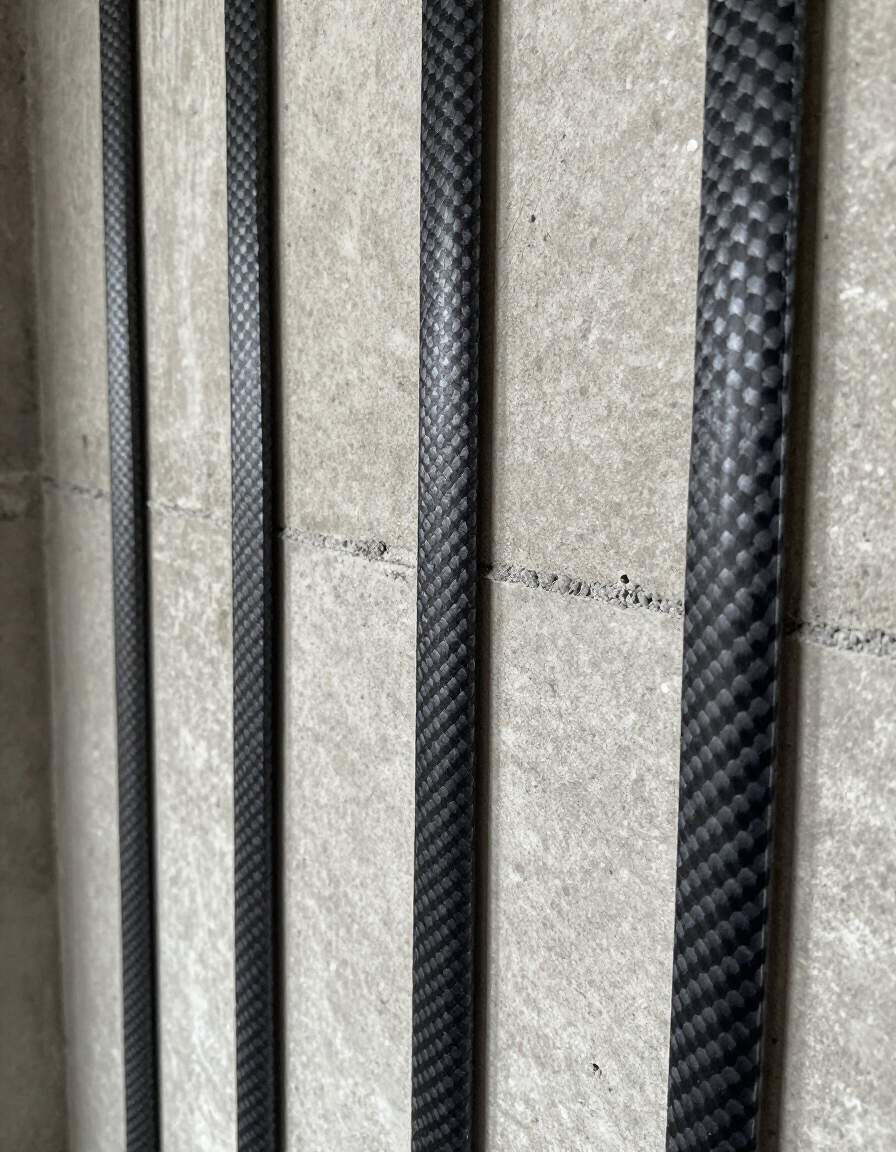
Carbon fiber straps, epoxied vertically along the interior face of the wall from the footing to the floor joists above, resist further inward movement by tying the wall to the structure above and below it, using the tensile strength of the carbon fiber material itself.
They are a common, effective, and less invasive repair, but only within a specific range of movement.
The honest threshold: carbon fiber straps are appropriate when wall deflection, how far the wall has bowed inward from a true vertical plumb line, is under roughly two inches.
Within that range, carbon fiber stops further movement effectively without the cost and disruption of excavation. Beyond roughly two inches, the wall has moved far enough that the straps cannot resist the accumulated lateral force going forward, and a different method is needed.
We measure deflection with a plumb bob or laser level referenced against the top and bottom of the wall during every evaluation, because that number, not a visual estimate, determines which repair method actually applies to your wall.
Beyond the roughly two-inch deflection threshold, three methods take over, in increasing order of invasiveness.
When Carbon Fiber Isn't Enough
Steel I-beam Bracing
Vertical steel beams are installed against the interior face of the wall, anchored at the footing and to the floor framing above, providing significantly more resistance to lateral pressure than carbon fiber straps alone. This is a common next step for walls beyond the carbon fiber threshold that have not moved so far that straightening is being considered.
Wall anchors & Helical Tiebacks
Anchors are installed through the wall and connect to helical tiebacks driven into stable soil in the yard beyond the zone of pressure causing the bow, allowing the wall to be gradually tightened back toward plumb over time, in addition to stopping further movement. This method requires yard access beyond the foundation for tieback installation, which is not available on every property.
Excavation & Rebuild.
For a wall that has moved severely, cracked extensively, or shows signs of imminent failure, excavating from the exterior to relieve soil pressure and rebuilding or substantially reinforcing the wall from outside is sometimes the only remaining option. This is the most invasive and costly method, reserved for walls beyond what anchors or beams can address.
Stabilizing Is Not Straightening
This distinction matters and gets glossed over by contractors eager to close a sale. Carbon fiber straps and steel I-beam bracing stabilize a wall, they stop further inward movement, but the wall stays in its current bowed position. Neither pulls a wall back toward its original plumb position.
Wall anchors with helical tiebacks are the one method that can gradually straighten a wall, incrementally tightening it back toward plumb over a series of adjustments, though even this has limits.
Full straightening generally requires the excavation-and-rebuild approach, and the cost involved means many homeowners reasonably choose stabilization over straightening once the wall has stopped getting worse. We explain which outcome each method actually delivers before you commit to one, so a homeowner expecting a flat wall from a carbon fiber installation is not disappointed by an outcome the method was never designed to produce.


When to Call a Structural Engineer
We are a waterproofing and foundation repair contractor, not a structural engineering firm, and we say that plainly rather than blur the line. For a wall with severe deflection, for a foundation showing multiple compounding problems, bowing combined with significant settlement, or cracking in multiple walls, or for any situation where you or we are uncertain whether the home's overall structural integrity is at risk, a licensed structural engineer's independent evaluation is the right next step before any repair method is chosen.
We recommend engineer involvement openly when a wall's condition calls for it, and we work from an engineer's specifications when a project requires one. Trust in the diagnosis matters more to us than any single job, and a homeowner making a decision this significant deserves an unbiased structural opinion when the situation warrants it.
For the full range of structural issues we address beyond bowing walls specifically, see our foundation repair page, and for wall cracks that may be an early sign of the same lateral pressure issue, see foundation crack repair.
Elite Basement Solutions serves Philadelphia, Bucks, Montgomery, Chester, and Delaware counties in Pennsylvania, and all of New Jersey (statewide). Licensed and insured, PA HIC #PA209149, NJ HIC #13VH14034100. Free on-site evaluation. Financing options available.
Frequently Asked Questions
What causes a basement wall to bow?
A basement wall bows inward when lateral soil pressure on the outside of the wall exceeds what the wall was built to resist.
The most common driver in this region is clay-heavy soil, which expands significantly when it absorbs water after rain and contracts as it dries, and repeated cycles of that expansion gradually push a wall inward over years.
Frost heave adds a seasonal factor: water against the foundation freezes and expands during cold months, then relaxes as it thaws, repeating the push each winter.
Poor grading or a failed drainage system that lets water pool against the foundation makes both mechanisms worse, since more water means more expansion and more freeze pressure.
A horizontal crack at or near mid-height in a block wall is often one of the earliest visible signs, sometimes appearing before any bow is obvious to the eye.
If you notice a horizontal crack, a wall that looks out of plumb, or doors and windows that have become harder to open, a free on-site evaluation can measure the actual deflection and identify the cause before it progresses further.
Can a bowing basement wall be fixed without excavation?
Yes, in many cases. Carbon fiber straps and steel I-beam bracing both install entirely from inside the basement with no exterior excavation, and both effectively stabilize a bowing wall within the appropriate range of movement.
Carbon fiber works well for walls with deflection under roughly two inches, beyond that, steel bracing or wall anchors become the more appropriate method.
Wall anchors with helical tiebacks also avoid excavating along the foundation wall itself, though they require exterior yard access beyond the wall to install the tiebacks in stable soil, a smaller footprint than full excavation, but not entirely interior work.
Excavation becomes necessary when a wall has moved beyond what interior methods can safely resist, when the wall requires straightening rather than stabilization, or when it is compromised enough, extensive cracking, or shifted block units, that reinforcing from the interior is not sufficient.
We measure your wall's actual deflection during a free on-site evaluation to determine honestly which category it falls into, rather than defaulting to the least or most invasive option.
How much does bowing wall repair cost?
Bowing wall repair cost depends primarily on which method the wall's deflection requires, and the difference between methods is substantial.
Carbon fiber strap installation, appropriate for deflection under roughly two inches, is the least expensive structural option since it requires no excavation. Steel I-beam bracing costs more, reflecting the additional materials and structural capacity involved. Wall anchors with helical tiebacks cost more still, since installation requires exterior excavation to place tiebacks in stable soil.
Excavation and rebuild, reserved for walls beyond what anchors or beams can address, is the most expensive option by a significant margin.
The number of walls affected, length of wall requiring treatment, and whether drainage correction is needed alongside the structural repair also factor into total cost.
We measure your wall's actual deflection and provide an exact quote during a free on-site evaluation, a number we cannot give accurately without seeing the wall in person.
Financing options are available. Call (800) 902-5311.
Is a bowing wall dangerous?
A bowing basement wall represents an ongoing structural problem that generally worsens over time if left unaddressed, since the same lateral soil pressure that caused the initial bow keeps acting on the wall, and clay expansion and frost heave cycles repeat every year.
Whether a specific wall poses an immediate safety concern depends on how much it has already moved and whether that movement is continuing.
A wall with a small amount of deflection that has been stable for some time is a different situation than one actively bowing further, with multiple horizontal cracks or shifting block units.
The latter warrants prompt evaluation, and in cases of severe deflection or compounding structural issues, an independent structural engineer's assessment is the right step, that determination is outside the scope of what a waterproofing contractor should diagnose alone.
We do not use fear-based language to sell a repair, but we also do not minimize a wall that has genuinely moved.
A free on-site evaluation gives you an actual deflection measurement rather than a guess, the number that determines both urgency and method. If our evaluation raises questions an engineer should answer, we say so directly.
What is the difference between carbon fiber straps and wall anchors?
Carbon fiber straps are epoxied vertically to the interior face of a basement wall, from the footing to the floor framing above, resisting further movement using the tensile strength of the material itself.
They install entirely from inside the basement, require no excavation, and are appropriate for deflection under roughly two inches, beyond that, they are not a reliable stand-alone repair.
Wall anchors work differently: a plate on the interior face connects through the wall to a helical tieback driven into stable soil beyond the zone of pressure causing the bow.
Because anchors connect to solid ground beyond the problem area, rather than just bracing against the structure above and below, they resist significantly more lateral force than carbon fiber, making them appropriate for greater deflection.
The other meaningful difference is capability: anchors can be gradually tightened over time to pull a bowed wall back toward plumb, moving toward straightening in a way carbon fiber, which only stabilizes the wall in its current position, cannot.
Anchors do require exterior yard access for the tieback, which carbon fiber does not need. We recommend the method that matches your wall's actual measured deflection, not the one requiring the least yard disruption.